
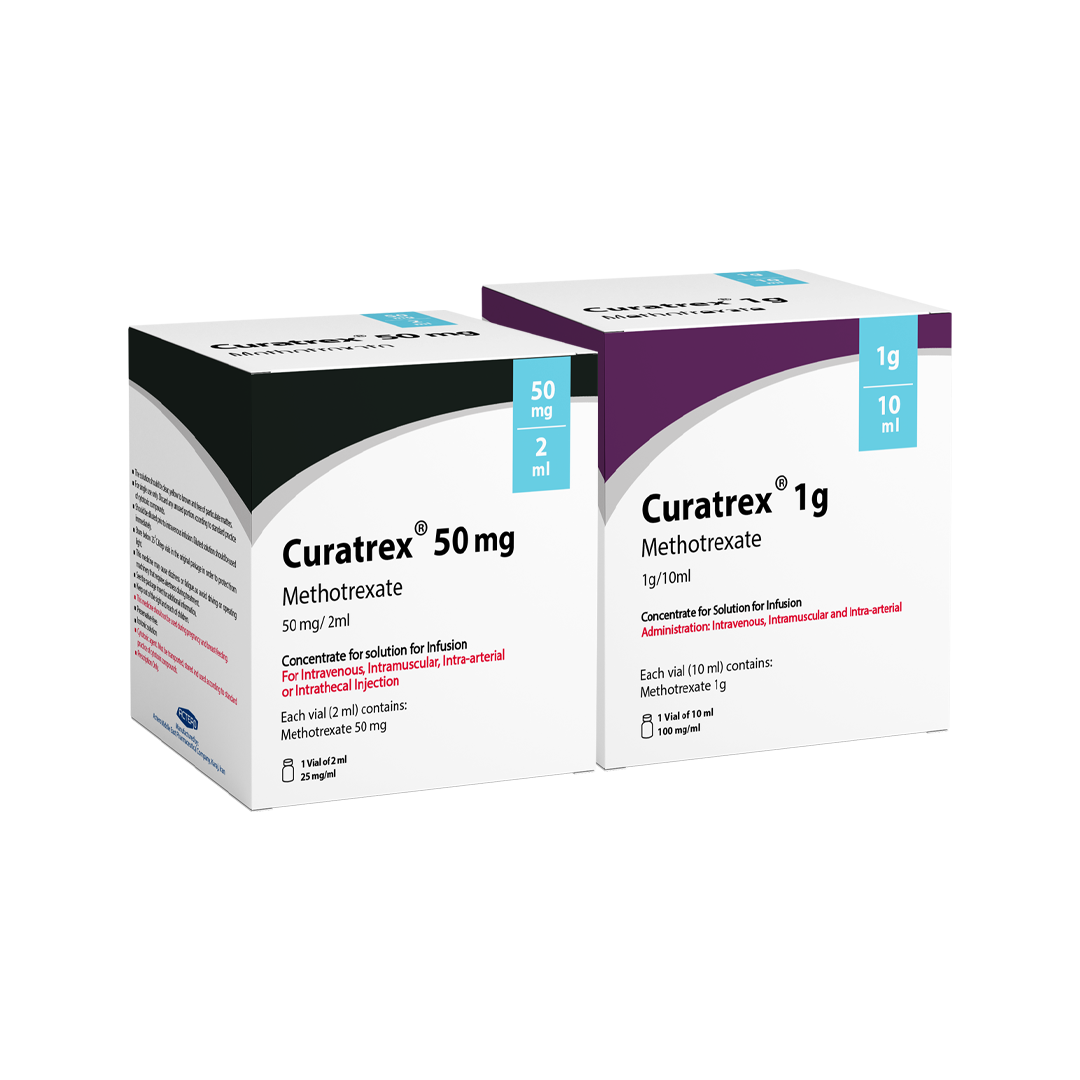



Curatrex® is a folate analog and in moderate and high doses acts as an antimetabolite, affecting the way cells in the body grow and preventing the growth of cancer cells. Curatrex® can be prescribed alone or in combination with other anticancer drugs (in accordance with known treatment regimens) in the treatment of the following cancers:
Curatrex® should not be prescribed in the following cases:
History of allergy to Curatrex®/Methotrexate or any of its side effects, severe kidney or liver disease, blood disorders such as anemia or low white blood cell or platelet counts, presence of infection in the body, Immune system problems, breastfeeding, pregnancy or planning to become pregnant.
Acute pulmonary hemorrhage has been reported in some patients with underlying rheumatologic diseases taking methotrexate. If you experience symptoms such as coughing up blood, you should contact your doctor immediately.
Tell your doctor immediately if you develop neurological symptoms, including generalized muscle weakness, visual disturbances, problems with thinking or memory, or disorientation leading to confusion and personality changes, as these symptoms may indicate a very rare but serious brain infection called
progressive multifocal leukoencephalopathy (PML) in people taking this medicine.
Your skin may become more sensitive to sunlight during treatment with Curatrex®. Therefore, avoid exposure to sunlight and do not use tanning beds (sunbeds) without consulting your doctor. To protect your skin from strong sunlight, wear adequate clothing or use a sunscreen with a high protection factor.
Curatrex® temporarily affects sperm and egg production.
Curatrex® can cause miscarriage and severe birth defects.
If you are a woman, you should avoid becoming pregnant while taking Curatrex® and for at least 6 months after stopping treatment. If you are a man, you should avoid having a baby or donating sperm while taking Curatrex® and for at least 3 months after stopping treatment.
Special care is necessary in patients taking Curetrex® in the following cases:
Previous stomach ulcers or inflammation and ulcers of the intestines (such as ulcerative colitis), any infection, patients with kidney problems, fluid accumulation in the lining of the lungs or abdomen due to illness, the patient’s need for radiotherapy, the patient’s need for vaccination, children, the elderly, and people with poor physical condition.
Recommended precautions and patient examinations:
Curetrex® is a cytotoxic product and should be used only with the prescription and supervision of a physician.
Even if Curetrex® is administered in low doses, there is a possibility of serious complications, so you should be monitored.
Curetrex® injections in medium and high doses prescribed in the treatment of cancers should be performed in medical centers and hospitals, and the patient should be hospitalized so that the necessary measures can be taken before starting treatment, during the injection, and after the injection of Curetrex®.
Before starting treatment:
The patient will have blood tests to check blood cell counts, liver function tests, liver infections, serum albumin (a protein in the blood), and kidney function. Sometimes, liver imaging or a liver tissue sample may be requested to further examine the liver. Sometimes, chest x-rays or lung function tests may be done to check for pulmonary tuberculosis. In women of childbearing age, a pregnancy test may be requested before starting treatment.
During treatment:
The doctor may perform any of the following procedures, sometimes several times:
Examination of the oral and throat mucosa for inflammation or mucosal ulcers,
Measurement of serum Methotrexate (Curetrex®) levels to prevent toxicity and reduce complications by determining the dose of leucovorin,
Blood tests (count blood cells), monitor kidney function and liver function,
Imaging of the liver and sometimes a small tissue sample to check liver health,
Monitoring of the respiratory system and, if necessary, imaging and lung function tests.
It is very important that you arrive on time for these procedures as recommended and so that your doctor can adjust your treatment based on the accurate results obtained.
Elderly patients:
Elderly patients treated with Curetrex® should be closely monitored by a physician so that possible side effects can be detected promptly. Due to impaired liver and kidney function in old age and also due to the reduced folic acid reserves in the body of elderly people, these people require lower doses of Curetrex®, which are determined by the physician according to the condition of each patient.
Taking Curetrex® with other medications:
Be sure to tell your doctor if you are taking, have recently taken, or plan to take any other medications or supplements, including over-the-counter medications, as some medications/supplements may interact with Curetrex®, including:
Nonsteroidal anti-inflammatory drugs such as Ibuprofen (used for pain relief) Aspirin or similar drugs (known as salicylates, which are blood thinners) Omeprazole, Esomeprazole, and Pantoprazole (used to reduce stomach acid) Diuretics , Diabetes or blood sugar-lowering drugs (including insulin and diabetes pills) Some antibiotics such as Penicillin, sulfonamides, Co-trimoxazole, Trimethoprim, Tetracycline, Chloramphenicol, and Para-Aminobenzoic Acid, Phenytoin (often used to treat epilepsy/seizures), Folic acid supplements, Antifolate drugs (such as pemetrexed and dapsone), Probenecid (used to treat gout), Nitrous oxide (for general anesthesia and pain relief) Nitrous oxide increases the effect of methotrexate and can lead to an increase in some side effects (such as low blood cell and platelet counts and mouth inflammation), Metamizole, Novaminsulfon and Dipyrone (for severe pain and/or fever), Retinoids, such as Acitretin (a medicine to treat psoriasis) or Isotretinoin (a medicine to treat severe acne), live virus vaccines, Mercaptopurine (to treat blood cell cancer), Theophylline (to treat asthma) and other medicines that may harm your kidneys or liver or blood cells.
Taking Curatrex® with food and drink:
Avoid alcohol during treatment with Curatrex® (risk of increased liver damage).
You should also avoid excessive consumption of coffee, caffeinated soft drinks and black tea.
Drink plenty of fluids during treatment with Curatrex®, as dehydration can increase the toxicity of Curatrex®.
Pregnancy and Breastfeeding:
Curatrex® should not be used during pregnancy or breast-feeding.
Pregnancy:
Do not take Curatrex® if you are pregnant or planning to become pregnant, as it may cause birth defects, harm to the fetus, or miscarriage. Unless your doctor determines that it is necessary for the treatment of cancer. You will be informed of these conditions so that you can make an informed decision.
Make sure you are not pregnant before starting treatment with Curatrex®. Do not use Curatrex® if you are planning to become pregnant.
Pregnancy Prevention:
Men and women should use effective methods of contraception during treatment with Curatrex®. Due to the nature of Curatrex®, this drug can cause genetic mutations and affect sperm production, which may be associated with the possibility of birth defects.
Women of childbearing age:
Must use effective methods of contraception during treatment and for 6 months after receiving the last dose of Curatrex® (consult your doctor).
If you become pregnant or suspect you are pregnant during treatment with Curatrex®, tell your doctor immediately.
Men with a sexual partner of childbearing potential:
Men with a sexual partner of childbearing potential should use effective contraception and avoid sperm donation during treatment and for 3 months after receiving the last dose of Curetrex®.
If your sexual partner becomes pregnant during treatment with Curetrex® or if you suspect that she is pregnant, tell your doctor immediately.
In cancer treatment, high doses of Curetrex® are often used and may cause infertility. Male patients undergoing cancer treatment who wish to have a child are advised to discuss sperm storage with their doctor before starting treatment.
Breastfeeding
Curetrex® is excreted in breast milk. Therefore, as there is a possibility of harm to the infant, avoid breastfeeding during treatment. You should consult your doctor about the exact time to start breastfeeding after receiving the last dose of Curetrex® (breastfeeding should be avoided for at least one week after receiving the last dose of the drug).
Driving and using machines
If you experience any side effects (such as dizziness, drowsiness or blurred vision), do not drive or use machines.
How is Curatrex® (Methotrexate – MTX) used?
Curatrex®50: Solution for injection for intravenous injection, intravenous infusion, arterial injection, intramuscular injection and intrathecal injection (with appropriate concentration and after dilution as prescribed by the physician)
Curatrex®1g: Solution for injection for intravenous injection, intravenous infusion, arterial injection and intramuscular injection (with appropriate concentration and after dilution as prescribed by the physician)
Please note that only the vial of Curatrex®50 can be used for intrathecal-intrathecal injection (after dilution with %9.0 normal saline solution without preservative).
Curatrex® 50
To prepare Curatrex® 50 for intravenous injection, intravenous infusion, arterial injection and intramuscular injection (doses less than 15 mg), % 0.9 normal saline without preservative or %5 dextrose without preservative can be used as diluent. The concentration of the injection solution will vary based on the prescribed dose. (Based on mg/m²)
Preparation of Curatrex® 50 injectable solution for intrathecal injection (IT):
This type of injection is the most sensitive type of Curatrex® 50 injection and the patient’s dose should be determined by an experienced physician with great care based on the type of disease and treatment protocol, health status, age, weight and renal function.
Curatrex® 50 should be diluted with % 0.9 sodium chloride injection solution without preservatives to a concentration of 1 mg/ml to have fewer complications. Intrathecal injection should be slow and each ml of the diluted solution should be injected into the spinal cord within 1 to 2 minutes.
Intrathecal injection of Curetex®, prepared at a dose of 50 mg, does not require the administration of leucovorin in most cases.
Intrathecal injection (IT) of Curetex® should not be administered concurrently with CNS radiotherapy, and an interval of at least 1–2 weeks before or after Curetex® injection is recommended for CNS radiotherapy.
Curetrex® 1 g
Curetrex® 1 g (1000 mg) can be administered by arterial, intramuscular, intravenous, and intravenous infusion. The concentrated solution in the vial should be diluted with %0.9 normal saline without preservative or %5 dextrose without preservative before use for all types of injections to a concentration of 5-20 mg/ml (depending on the patient).
Please note that only the Curetrex® 50 vial can be used to prepare the intrathecal injection solution and the Curetrex® 1 g vial should not be used for intrathecal IT injection.
The dosage of Curetrex® varies in each indication and according to the patient’s age. The nature of this molecule is such that at different doses, it has different therapeutic effects with different mechanisms of action.
This drug has immunomodulatory properties at low doses. Therefore, other pharmaceutical forms of Methotrexate with lower doses are used more in the treatment of rheumatological diseases.
In medium and high doses (above 100 mg per square meter of body), Curetrex® has antimetabolite properties (cell growth inhibitor) and is used in cancer treatment regimens. As mentioned, the therapeutic doses of Curetrex® in cancer patients are calculated in mg/m².
How to use Curetrex® in each indication:
Curetrex® is prescribed alone (monotherapy) or in combination with other chemotherapy drugs (combination regimens) in many cancers. Please note that the administration of Curetrex® (Methotrexate MTX) is carried out in compliance with the requirements for use, which are mentioned in each case, but may differ depending on the opinion of the treating physician.
Below is the method of using Curetrex® in each approved indication:
Acute Lymphoblastic Leukemia (ALL)
Adults
A) Maintenance therapy
• Dose: 20–40 mg/m² PO weekly
• With: daily 6-mercaptopurine
• Duration: ~2–3 years
B) CNS prophylaxis/treatment
• Intrathecal (IT): 12 mg per dose
• Often part of triple IT (Curatrex®50 + cytarabine + hydrocortisone)
C) High-Dose MTX (HD-MTX) – consolidation
• 1–5 g/m² IV over 24 h
• Every 2–3 weeks
• Mandatory leucovorin rescue
Pediatrics:
A) Maintenance
• 20 mg/m² PO weekly
B) Intrathecal (age-adjusted dosing)
• <1 yr: 6 mg
• 1 yr: 8 mg
• 2 yr: 10 mg
• ≥3 yr: 12 mg
C) HD-MTX
• 2–5 g/m² IV (protocol dependent)
• With leucovorin rescue
Non-Hodgkin’s lymphoma (NHL):
Adults:
a) Prophylaxis or CNS involvement
• IT MTX: 12 mg – only Curetex® 50 (after dilution) each chemotherapy cycle
b) Selected systemic regimens
e.g. in high-risk lymphomas:
• HD-MTX: 3–3.5 g/m² IV on days 10–15 of cycle
• In combination with leucovorin
c) Some protocols
• R-CHOP + HD-MTX in high-risk CNS lymphomas (relapse)
Pediatrics:
• Same as ALL in some protocols:
o High dose 1–5 g/m² IV
o With rescue leucovorin
• IT may also be used according to protocol. (Curatex® 50 only after dilution)
Primary Central Nervous System Lymphoma (PCNSL)
MTX is the mainstay of treatment.
Standard regimen:
• HD-MTX: 3.5–8 g/m² IV
• 3–4-hour or 24-hour infusion
• Every 10–14 days
Common combinations
• MTX + Rituximab
• MTX + Cytarabine
• MATRix regimen:
o MTX + Cytarabine + Thiotepa + Rituximab
Pediatric (rare)
• Similar HD-MTX strategy
• 3–8 g/m² IV
Supportive requirements
• Leucovorin rescue mandatory
• Monitoring serum MTX levels
Osteosarcoma (Osteosarcoma):
Adults:
High-dose MTX is the backbone of treatment.
HD-MTX
• Dose: 8–12 g/m² IV
• 4–6-hour infusion
As a MAP regimen
• M: Methotrexate (HD)
• A: Doxorubicin
• P: Cisplatin
Notes
• Leucovorin rescue
• Monitoring of MTX levels
• Repeat every 2–3 weeks
Pediatric:
As part of combination regimens (e.g. MAP regimen)
• High-dose: 8–12 g/m² IV
• With rescue leucovorin and close monitoring of drug levels
Breast cancer
Less commonly used today but is present in some regimens.
CMF regimen
• C: Cyclophosphamide
• M: Methotrexate
• F: 5-FU
MTX dose
• 40 mg/m² IV days 1 and 8
• 28-day cycle
Uses
• Adjuvant (after surgery) in selected patients or resource-limited settings
Head & Neck Squamous Cell Carcinoma (HNSCC)
Adults:
Palliative monotherapy
• 40–50 mg/m² IV weekly
OR
• 60 mg/m² IV every 2–3 weeks
No pediatric indication.
Gestational Trophoblastic Neoplasia (GTN)
Adults (women of reproductive age)
A) Low-risk GTN
Weekly regimen:
• 30–50 mg/m² IM weekly
OR
8-day MTX/Leucovorin regimen:
• MTX 1 mg/kg IM on days 1,3,5,7
• Leucovorin 0.1 mg/kg on days 2,4,6,8
B) High-risk (EMA-CO regimen)
• 100 mg/m² IV bolus
• Then 200 mg/m² IV infusion over 12 h
Not applicable to children.
Bladder Cancer
Adults
MVAC regimen
• 30 mg/m² IV on days 1, 15, 22
• Combined with vinblastine, doxorubicin, cisplatin
No pediatric role.
Your doctor may prescribe Curatrex® for a condition other than those listed above.
Or, your doctor may prescribe Curatrex® together with other types of chemotherapy drugs. If you have any questions about these, you should ask your doctor.
Do not use diluents containing preservatives (such as benzyl alcohol) to prepare Curatrex® for injection.
The product in each vial should be clear, yellow to orange, and free of particles; otherwise, do not use it.
Curatrex® must be carefully diluted and prepared for injection by a doctor, pharmacist, or trained personnel. The preparation should be sterile, air-free, and with careful dose control. The solution for injection should also be clear and free of particles.
Critical requirements for the use of Curatrex® in medium and high doses:
The patient receiving Curatrex® should not be dehydrated. For this purpose, intravenous solutions are administered 6 to 12 hours (sometimes 24 hours) before the injection of Curatrex®, during the injection and after it, to eliminate dehydration and the patient’s urine volume reaches at least 100-200 mL/m²/h. After the end of the Curatrex® injection, serum intake is continued until the serum level of Curatrex® (Methotrexate) in the patient reaches a safe range.
In these patients, urine alkalinization should be performed at the same time. For alkalinization, sodium bicarbonate is usually added to the patient’s serum at a rate of 50–100 mEq per liter of serum before the injection of Curatrex® to maintain urine acidity above 7. Urine alkalinization should be started before the injection begins and then continued during and after the injection.
Note that the amount of serum and bicarbonate intake is determined by the attending physician and according to the necessary points. Serum injection and urine alkalinization prevent the precipitation of Curatrex® (Methotrexate) in the kidneys and the occurrence of renal failure.
Given the way this drug works, which prevents the proliferation of cancer cells by inhibiting folate, and given that healthy cells also need folate for proper function and survival, to prevent possible damage to other organs of the body, including the liver, kidneys, nervous system, and mucous membranes, an injection of Leucovorin (Folinic acid) is added 24–36 hours after the injection of Curatrex® to save healthy tissue cells. (Rescue therapy)
The amount of Curatrex® (Methotrexate) in the blood of patients is regularly measured after the injection to determine the necessary amount of leucovorin and the intervals between its injections, based on the amount of the drug in the blood.
It is worth noting that in rheumatology, injectable Methotrexate is used as a first-line DMARD (especially in rheumatoid arthritis, psoriatic arthritis, some vasculitis, etc.) and its dosage is completely different from oncology doses. The maximum injectable dose commonly used in rheumatology is 20-25 mg per week, intramuscularly or subcutaneously, which is gradually increased based on the patient’s response and tolerance. Therefore, toxicity or poisoning with the drug is very rare. Another difference in rheumatology regimens is the use of oral folic acid, which is sufficient to prevent the drug from affecting healthy cells and is considered instead of leucovorin injections,
(1 mg daily / or 5 mg of oral folic acid weekly one day after methotrexate injections).
Possible side effects:
Curatrex® is a very toxic drug and can have adverse effects that may be dangerous or
life-threatening, so you should be aware of any side effects during treatment to minimize the harm caused by possible side effects by using Curatrex® optimally and enjoying the desired benefits.
Keep in mind that some of these are very serious and may require immediate medical attention, so tell your doctor as soon as possible if any of the following occur:
Severe allergic reaction: You may experience a sudden itchy rash (hives), swelling of the hands, feet, ankles, face, lips, mouth or throat, which may cause difficulty swallowing or breathing, and you may feel faint.
Low blood pressure: You may feel faint.
Pneumonia with shortness of breath: You may have a persistent cough, experience pain or difficulty breathing, or be short of breath. These symptoms may be related to changes in a certain type of white blood cell in your blood.
Signs of infection: Such as fever, chills, body aches, sore throat.
Unexpected bleeding: Such as bleeding gums, seeing blood in your urine or vomit, unusual bruising, a broken blood vessel, or gastrointestinal bleeding as indicated by black or tarry stools.
Mouth sores: Especially if you develop multiple sores or blisters inside your mouth or on your tongue.
Skin problems: Can include a wide range of symptoms, including skin rashes or blisters on the surfaces of the eyes, nose, vagina, or anus, acne, skin redness and/or peeling, itching or the appearance of light spots on the skin, sunburn-like reactions due to increased skin sensitivity to sunlight frequently and unusually, and hair loss.
Gastrointestinal symptoms: Diarrhea, abdominal pain, oily stools, stomach pain, loss of appetite, feeling or being sick and vomiting.
Chest pain: which may be due to heart or lung problems.
Neurological symptoms: Seizures, blurred vision, headache and/or dizziness, drowsiness, difficulty/inability to speak, and weakness in the legs that sometimes spreads to the upper limbs and face and may lead to paralysis, effects on learning and memory, mood changes, ringing in the ears, numbness or tingling, and less sensitivity to stimulation than normal.
Diabetes: You may need to drink more than usual.
Osteoporosis: Bones that break easily.
Vascular problems: Vasculitis (pain or redness of blood vessels), a blood clot inside a blood vessel that causes pain, swelling, or redness and can occur in the veins of the brain, deep veins, retinal veins, or even arteries.
Jaundice: Yellowing of the skin and whites of the eyes.
Bladder inflammation (cystitis): You may need to urinate more often than usual (with or without pain).
Menstrual problems in women: Irregular periods, sometimes stopping completely.
Feeling tired or unwell.
*Possible side effects for patients with underlying rheumatic disease:
*Cough with bloody sputum: This side effect has been reported for methotrexate used in patients with underlying rheumatic disease.
*Injection site reaction: Inflammation of the skin at the injection site, dark red or black spots around the injection site, often with pain, sometimes necrosis of the injection site (frequency not known)
If any of the side effects get serious, or if you notice any other side effects not listed, please tell your doctor. By reporting side effects, you can help provide more information about the safety of this medicine.
Curatrex® storage conditions:
Keep the medicine out of the sight and reach of children.
Do not use the medicine after the expiry date stated on the vial and box.
Until and before use, store the medicine at a temperature below 25°C and in the original packaging to protect the product. The product is cytotoxic, it should be transported, stored and used in accordance with the instructions for cytotoxic drugs.
The vials do not contain preservatives and are for single use. Discard any remaining medicine in accordance with the instructions for cytotoxic drugs.
It is best to inject immediately after diluting the medicine and preparing the solution. The dilution method for each injection method is explained in the “How to use” section.
Also, if you need to store the prepared solution, you can only store it for up to 4 hours at room temperature (20-25°C) or up to 24 hours in the refrigerator (2-8°C).
Do not throw away any medicines via wastewater or household waste. This will help protect the environment.
What Curatrex® looks like and contents of the pack:
The active ingredient of this medicine is Methotrexate (MTX).
Appearance of Curetrex®: Clear, sterile, preservative-free solution, yellow to orange in color and free of particles. Otherwise, do not use.
Curetrex® is available in the following forms:
Curetrex® 50 mg:
Each box contains 1 glass vial of 50mg, containing 2 ml of solution for injection, containing 50 mg of Methotrexate (25 mg/ml) along with an instruction sheet.
Other ingredients of Curetrex®50(25 mg/ml) are: sodium chloride, sodium hydroxide, hydrochloric acid and water for injection.
Curetrex® 1 g:
Each box contains 1 glass vial of 1 g, containing 10 ml of solution for injection, containing 1 g (1000 mg) of Methotrexate (100 mg /ml) along with a leaflet.
Other ingredients of Curetrex®1g(100 mg/ml) are: sodium hydroxide, hydrochloric acid and water for injection.